The Challenge
Discover Oshkosh’s 2026 Riverwalk placemaking program had a hard wall and a soft problem. The hard wall: nearly 600 square feet of blank white cinderblock on the back of Greene’s Pour House at The Granary, facing a rear parking lot in the Sawdust District. The soft problem: a temporary Riverwalk detour was about to pull cyclists and pedestrians off the Fox River and past this wall, and the program wanted two things from whatever went on it. Activate the detour so the walk felt worth taking, and help establish the “Sawdust District” as a brand.
The easy version of this job is a Fox River landscape or a tasteful abstract. It fills the wall and satisfies no one in particular. The real brief was harder and unstated: the district is named for a history it does not actually tell. A mural that earned the name, instead of decorating around it, was the difference between wall art and placemaking.
Approach
I treated the commission as research first and paint second, because for a district-defining wall the content is the credibility.
The Sawdust District is named for Oshkosh’s lumber boom: 47 sawmills by 1874, a company town built and rebuilt by immigrant mill families. The official story keeps the owners’ names, Paine and Sawyer and McMillen, and loses almost everyone who held the neighborhood together. I went looking for the people the story leaves out and found them in the foundational scholarship on the 1898 Oshkosh woodworkers’ strike, which I read in full rather than in summary.
That research produced a named cast, not a generic homage: Lizzie Hando, the 64-year-old widow who could read English but not speak it and led the march on the McMillen mill; Emma Kunzendorff, the literate one who wrote the letter that refuted the newspapers; Caroline Pomerening, who stood up in court and shouted the judge down; and the boy the crowd carried to an unmarked grave. The residence maps in that scholarship place these women’s homes within blocks of this exact wall. The mural would face the neighborhood they actually walked.
The visual register came from the research too. The scholarship opens on a Käthe Kollwitz etching of working people at a millowner’s gate, so the wall is painted in the weight of Kollwitz and the icon tradition, working women rendered like saints, rather than in a soft folk-illustration style. That was a deliberate choice with a source behind it, the kind of decision a placemaking committee can defend to a board.
The Work
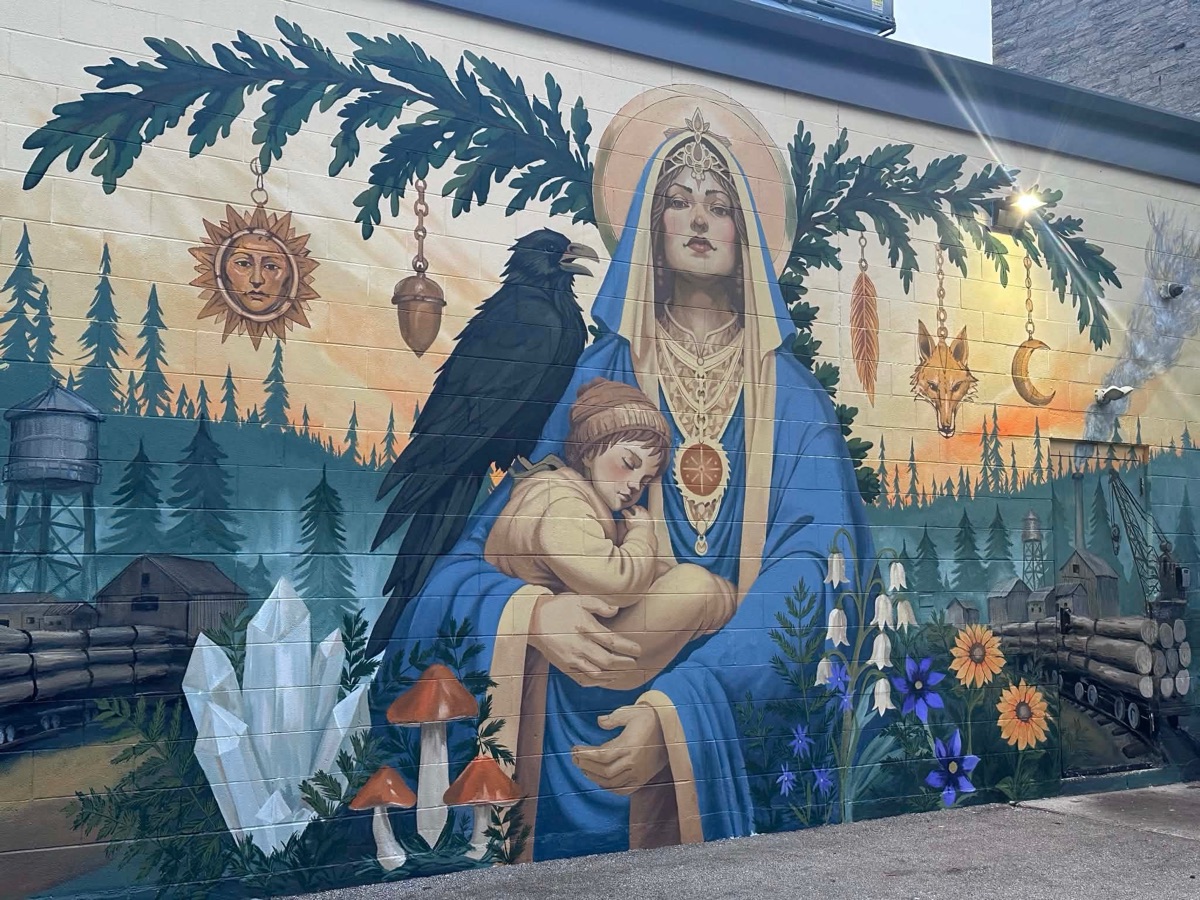
The result is Mill Madonnas: a monumental Madonna in a blue robe holding a sleeping child, crowned in white pine hung with small tokens of the world the sawdust buried, a raven at her shoulder as the scribe of the wall. On either side of her the mill town works on, log trains and water towers and smokestacks, with wildflowers and mushrooms coming back through the cutover at her feet. She is not a portrait of one woman but a single figure carrying all of them. She reads at highway scale and rewards a close look, which is what a wall on a walking detour needs to do.
The making was a managed production, not a solo improvisation. The design began as a pencil sketch whose bones never changed, so the client knew early exactly what the wall would become. The cinderblock was primed white across ~597 square feet and worked from a lift. The sky went on first, an orange sunset sweep laid across the block. After dark the full line drawing was projected onto the underpainting and traced by hand at full scale, so a landscape-scale composition kept the integrity of the original drawing. Then the long work of paint: the robe, the forest, the mill town filling in around her. The linework, faces, and signature elements stayed hand-painted, with the on-site team structured so skilled work and fill work went to the right people (I co-designed with Erin LaBonte, with David Carpenter painting alongside us) and the production planned around a limited number of high-value site days.
We also built the wall a permanent record: the full history behind the mural, sourced and cited, published so the district’s story finally has somewhere to be read. Doing the research is a service; publishing it is what turns a mural into placemaking infrastructure.
Results
- Announced by Discover Oshkosh on August 10, 2026 as the second work in the 2026 Riverwalk public art series. “We see these placemaking projects as an accessible way for residents and visitors to engage with Oshkosh’s story,” said Amy Albright, director of Discover Oshkosh. That is the placemaking goal, in the client’s own words, met.
- A district-defining wall delivered at scale, ~597 square feet, complete and public, on the Riverwalk detour it was commissioned to activate.
- It writes its own press. A named, researched, memorial subject gives the program a story to tell that a generic wall never could.
- The commission came as a direct award off prior work through the same channel, so the trust was in the work itself, and that channel is now a repeat relationship rather than a one-off.
- A permanent, cited public history of the Sawdust District and the 1898 strike women now exists online because the mural required it, an asset that keeps working for the district long after the ribbon.
The 1898 strike failed, and the mural is built as a memorial rather than a celebration. That was the intent, not a compromise, and it is why the wall lands as civic history instead of decoration.
See the full history, sources, and process behind the mural at yonderartland.com/projects/oshkosh-granary-mill-madonna.